

The Question That Built a Global Team Science Company
11 February 2026
In 1985, two researchers at the University of Queensland asked a question that would transform how organisations think about teams. Four decades later, their answer has helped over 2.5 million professionals across 190 countries and it’s still evolving.
It Started With a Frustration
Dr Charles Margerison and Dr Dick McCann were fascinated by a deceptively simple problem: why do some teams consistently outperform others, even when the individuals involved have similar skills and experience?
The existing tools didn’t help much. Personality assessments of the era sorted people into static boxes, useful for understanding individuals, perhaps, but largely silent on the dynamics that make teams succeed or fail.
Margerison and McCann saw something different. They saw the untapped potential that emerges when individuals understand not just who they are, but how they contribute to something greater. So they asked a radical question:
“What if we stopped labelling personalities and started building high-performing teams instead?”
That question would become the foundation of Team Management Systems.
A New Way of Seeing Work
What set their research apart was where they started. Most assessments of the time began with clinical psychology and adapted it for the workplace. Margerison and McCann did the opposite and began with work itself.
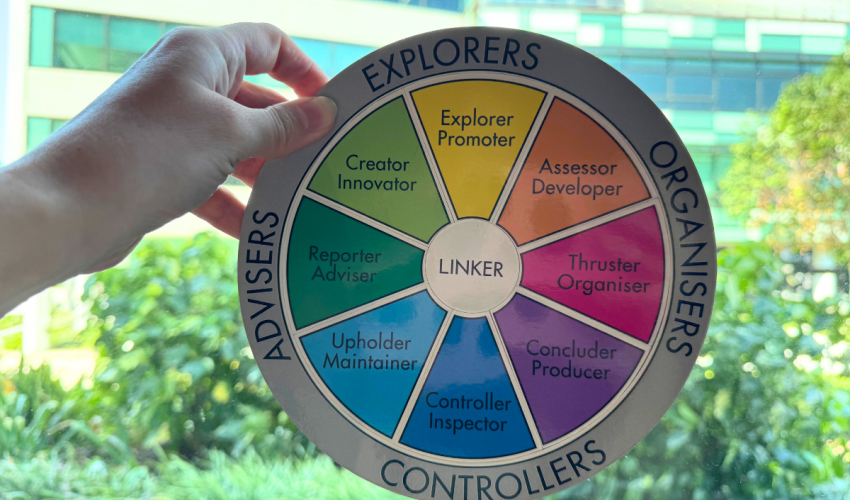
They studied high-performing teams across industries and identified a pattern: every successful team needs eight distinct types of work to be covered: advising, innovating, promoting, developing, organising, producing, inspecting and maintaining, with linking (glue skills including communication, delegation, objective setting, problem solving and team development) at the center holding it all together.
This became the Types of Work Wheel, a fundamentally new framework for understanding what teams actually need to do at work specifically.
From Work to People: The Team Management Wheel
Building on this foundation, Margerison and McCann developed a companion model: the Team Management Wheel.
Where the Types of Work Wheel mapped out what needs to happen, the Team Management Wheel revealed who is naturally drawn to each type of work.
The wheel identifies eight role preferences: Reporter-Adviser, Creator-Innovator, Explorer-Promoter, Assessor-Developer, Thruster-Organiser, Concluder-Producer, Controller-Inspector, and Upholder-Maintainer: showing where each person’s motivation flow and what energises them.
The insight was elegant: rather than labelling people, the wheel illuminated how individual preferences complement each other within a team. Understanding wasn’t just about individual self-awareness, it was whole team awareness.
The Team Management Profile
These two interconnected models became the basis for the Team Management Profile (TMP), the world’s first complete methodology for systematically building high-performing teams. It launched in 1985 and quickly gained traction because it worked.
Work + people = people at work. That formula meant TMS tools were practical from day one. They spoke the language of managers, team leaders and consultants who needed to solve real problems arising in the work environment.
From Brisbane to 190 Countries
What started at one university grew into a global movement. Team Management Systems was founded in Brisbane in the late 1980s, and the practitioner network expanded rapidly. By the 1990s, the QO2 Profile had been added to understand how people approach risk and opportunity.
In the 2000s, Window on Work Values (WoWV) explored the alignment between personal values and workplace culture, and the Linking Leader Profile (LLP|360) addressed the leadership capabilities that connect and inspire teams.
Each new tool built on the same foundation: rigorous science, designed for the realities of work, focused on team, not just individual, performance.
The suite earned British Psychological Society registration and has been continuously refined over four decades.
The Compliment of Imitation
We take it as a compliment that other profile providers have copied the models and approach created by our founders 40 years ago. What made Team Management Systems different then continues to hold strong and still sets us apart today: the depth of the science, the work-first philosophy and the focus on the connections between people to work as a whole.
The Next Chapter: TeamOS™
In 2026, Team Management Systems is launching TeamOS™, the next generation of team performance technology.
TeamOS™ brings 40 years of psychometric science into the flow of daily work, powered by AI. It’s built on the principle that understanding your team should be as natural as checking your calendar.
AI-powered coaching, personalised insights, real-time guidance for leaders and team members, all grounded in the same research that Margerison and McCann began at the University of Queensland four decades ago.
Find out more about TeamOS™ and get early access here.
Forty Years On
The question Margerison and McCann asked in 1985: "What if we built tools for teams, not just individuals?" turned out to be the right one. Over 2.5 million professionals across 190 countries have discovered what makes teams truly thrive.
The tools have evolved. The science has deepened. The technology has transformed. But the purpose remains unchanged: to ignite human potential at work.